
To read AliExpress specs without getting misled, verify the chip/sensor part numbers, demand traceable evidence (markings, firmware, real photos), sanity-check performance claims with quick tests, and treat review scores as a trend-not a single number. This guide focuses on electronics: chips, sensors, materials, and review signals you can validate with free tools.
At-a-glance verification checklist
- Match the exact chip/sensor part number (full code) to a manufacturer datasheet or trusted distributor listing.
- Reject listings that show only generic terms (e.g., "high performance MCU", "industrial sensor") without markings or PCB photos.
- Cross-check photos: look for consistent silkscreen, package type, and readable top-mark codes.
- Validate "materials" claims with measurable cues (weight, magnet test, finish, fastener type), not marketing adjectives.
- Read reviews for evidence density (real photos, measurements, long-term updates), and for time-based drift after batches change.
- Prefer sellers who answer technical questions with specific identifiers (part code, firmware version, test conditions).
Decoding chip and SoC labels: what markings mean in practice
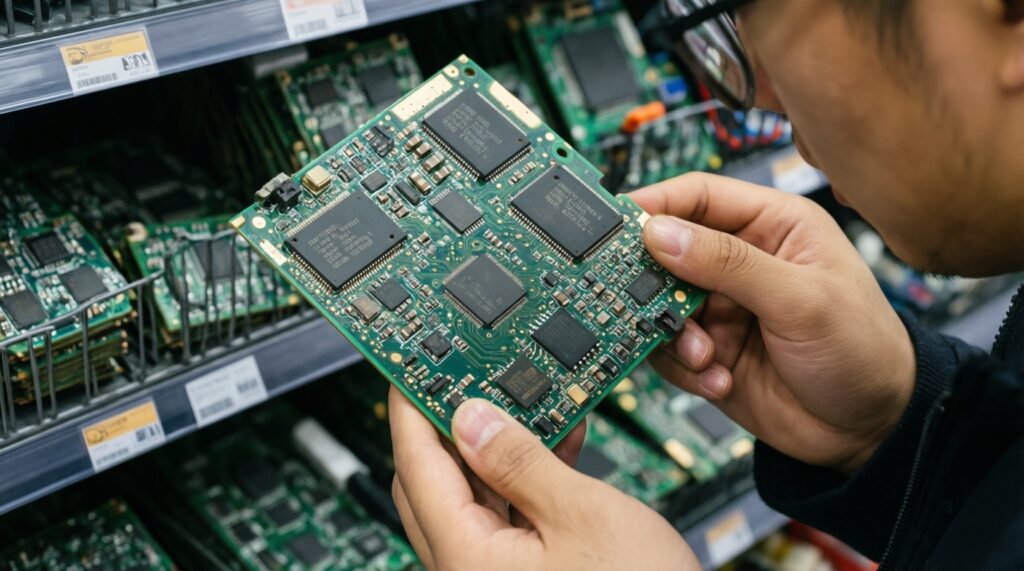
- Use this when you are buying electronics on AliExpress (modules, dev boards, sensors, cameras, power supplies) where the exact IC determines compatibility and safety-especially for "ซื้อสินค้าอิเล็กทรอนิกส์ AliExpress ชิป เซ็นเซอร์ วัสดุ".
- Expect limitations because many ICs use abbreviated top-marks; you often need the PCB context (package + surrounding components) to confirm identity.
- Do not do this for safety-critical applications (medical, life support, mains wiring without certified enclosure) or when counterfeit risk is unacceptable; buy from authorized channels instead.
- Stop immediately if the seller refuses to provide a clear photo of the chip top-mark or a link to the exact datasheet.
Quick reference table: common codes, what to verify, and reliable places to cross-check
| Item type | What sellers often show | What you should verify | Free / low-cost cross-check | Red-flag pattern |
|---|---|---|---|---|
| MCU module (e.g., "STM32", "ESP32") | Family name only | Full part number, package, flash size, RF front-end parts (for ESP32) | Manufacturer datasheet; board schematic if provided; compare chip top-mark photo | "Compatible with STM32" without part code; blurry chip photo; no RF matching network on "ESP32" board |
| IMU (gyro/accel) | "6-axis/9-axis" claim | Exact IMU model; interface (I2C/SPI); noise/bias class; voltage range | Datasheet; run a simple bias stability test after warm-up; compare register map via library examples | Too-good-to-be-true accuracy with no test conditions; reviews mention drift/temperature issues |
| Temperature sensor | "High precision" | Sensor model; accuracy range and conditions; calibration method | Ice-water/ambient reference checks; compare to known-good sensor; datasheet tolerance table | Lists "±0.1°C" without range; no mention of calibration; mixed sensor photos across reviews |
| Camera sensor module | "4K / 48MP" headline | Sensor model; lens specs; true output mode; interface bandwidth | Search sensor model + datasheet; check firmware/app output resolution and bitrate; look for real sample files | Only interpolated resolution; no sensor model; identical promo images across stores |
| Power IC / charger module | "Fast charge / high current" | Controller IC model; thermal design; inductor/diode ratings; protection features | Datasheet; inspect PCB copper area; inexpensive USB meter / load test | Inflated current rating with tiny inductor; no thermal photos; user reports overheating |
Sensor specifications vs real performance: tests, bias and datasheet traps
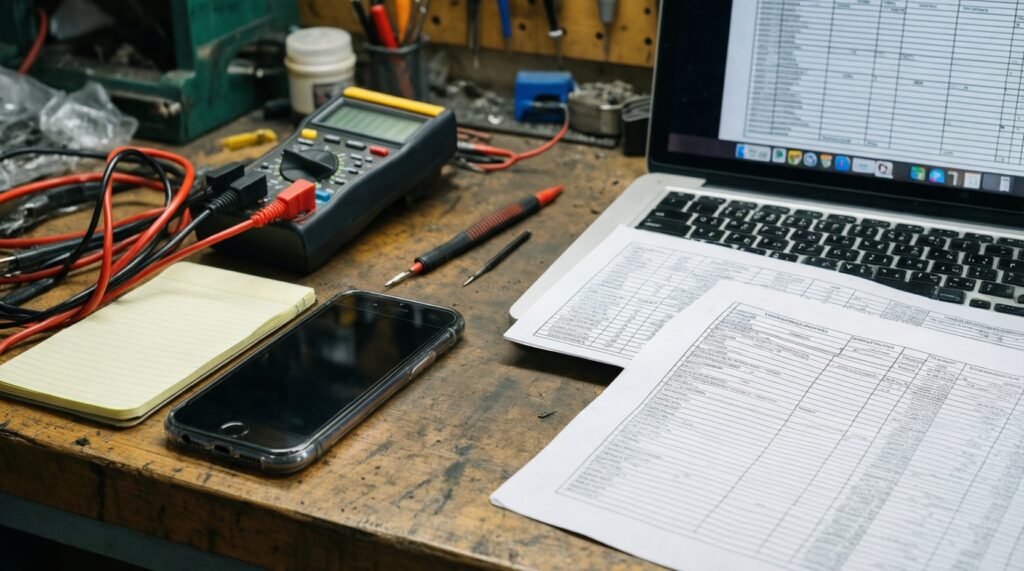
- Free tools: a smartphone (for photos/video), a note app/spreadsheet, and a datasheet search workflow (manufacturer site + cached copies).
- Low-cost tools (optional but useful): USB power meter, digital scale, calipers, magnet, and a basic multimeter.
- Software access: Arduino/PlatformIO or Python for quick readouts; a known-good library to confirm register IDs.
- Test environment basics: stable surface, repeatable temperature (avoid direct sun), and a "known reference" device/sensor for comparison.
- Evidence capture: save screenshots of the listing specs and seller chat; this helps disputes if the item is not as described.
Materials and build: spotting misleading photos and vague descriptors
Preparation mini-checklist (before you trust any spec)
- Open the listing on desktop view and expand all specification sections; take screenshots of the claims.
- Collect at least 3 real-customer photos from reviews (not only seller images) and compare them side-by-side.
- Write down the exact keywords you will challenge (e.g., "CNC aluminum", "304 stainless", "industrial grade").
- Prepare 2 questions for the seller that force specifics (part code, coating type, thickness, standards).
- Decide your acceptance criteria (e.g., "must have readable chip marking photo" or "must show magnet test result").
-
Translate vague material words into testable properties
Convert "premium metal" into measurable checks: weight, magnet response, finish quality, and fastener type. If the seller cannot state a grade (e.g., stainless type, aluminum series) treat it as unknown.
- Ask: "What alloy/grade is the body and what is the surface finish (anodized/painted/plated)?"
- Ask for a close-up photo of threads, edges, and screw heads.
-
Compare seller photos to review photos for batch changes
Look for swapped connectors, different PCB color, missing shielding cans, or different label fonts. Batch drift is common on AliExpress even under the same product URL.
- Zoom in on silkscreen version text (e.g., "V1.2") and connector part numbers.
- Flag listings where review photos show multiple different boards.
-
Check enclosure and assembly cues that correlate with reliability
Prefer consistent screw spacing, proper strain relief, and clean solder joints. For power items, look for insulation distances and a real fuse/NTC when relevant.
- Reject "glued-only" assemblies when the item will be stressed mechanically.
- For mains-related products, avoid anything lacking clear safety markings and internal photos.
-
Demand exact chip/sensor identification on the PCB
For modules, the component is the product. Request a sharp top-down photo where chip markings are readable; if they send a blurred crop, assume it is intentional.
- Ask: "Please confirm the exact IC marking on the main chip (top-mark text)."
- Ask for a photo taken at an angle to show package thickness (helps distinguish similar packages).
-
Do a quick on-arrival inspection and simple tests
When the package arrives, record an unboxing video, then run the fastest "go/no-go" checks before the dispute window closes. This is a core part of เทคนิคซื้อ AliExpress ไม่ให้โดนโกง.
- Weigh the item and compare to any stated weight; big deviation suggests different material or missing parts.
- Run a short functional test (power draw, sensor ID read, baseline noise) and save logs.
Review scores that matter: weighting verified purchases and temporal trends
- Filter for reviews with real photos/video and technical detail; ignore one-line praise.
- Prefer reviews that mention measurable outcomes (fitment, readings, stability) over "looks good".
- Check whether negative reviews cluster in a recent period (possible supplier/batch change).
- Look for reviewers who mention the exact part number, firmware version, or interface behavior.
- Down-rank reviews that only repeat listing claims (often incentivized).
- Verify that "verified purchase" (or equivalent platform indicator) is present where applicable.
- Scan for dispute/return mentions: "not as described", "fake chip", "different material", "overheats".
- Answer "AliExpress รีวิวเชื่อถือได้ไหม ดูยังไง" by prioritizing evidence density, recency, and consistency across reviewers-not the average star rating alone.
Cross-checking claims: using databases, serial checks and firmware evidence
- Assuming a family name implies authenticity (e.g., "STM32" ≠ a specific MCU; clones exist).
- Trusting a single screenshot of a "datasheet" hosted by the seller (it may be edited or for a different variant).
- Ignoring package and pinout mismatches; two chips can share a name but not the same pin map.
- Not verifying sensor identity via register ID / WHO_AM_I reads when the interface supports it.
- Accepting "same as brand X" claims without firmware evidence (boot logs, version string, or command responses).
- Skipping cross-check with reputable distributor listings (use them as a reference for naming, variants, and package codes).
- Confusing "peak resolution" with usable performance (noise, drift, temperature coefficients matter more).
- Overlooking that review photos may show a different revision than what ships today.
- Not preserving proof (screenshots + chat); this weakens disputes for "not as described".
Buying strategy: red flags, safe alternatives and negotiation tactics
- Buy from authorized distributors (best for authenticity): use when you need guaranteed genuine parts or safety compliance; treat AliExpress as a last resort for that bill of materials.
- Choose well-known module brands on AliExpress (pragmatic middle ground): use when you need predictable documentation/community support; still verify markings because resellers can mix stock.
- Buy dev boards for prototyping, not "bare chips" (lower counterfeit risk): use when your goal is learning/testing; verify with firmware/readout tests on day one.
- Negotiate for evidence before paying (risk control): ask for real chip top-mark photos, PCB revision, and a short functional video; this is central to วิธีดูสเปก AliExpress ให้ไม่โดนหลอก and วิธีเลือกซื้อสินค้า AliExpress ของแท้.
Concise answers to recurring buyer doubts
Is a high star rating enough to trust a listing?
No. Use the rating only as a starting filter, then validate with photo/video reviews, recency trends, and proof of the exact part number.
What is the fastest way to detect a fake or swapped chip?
Demand a readable top-mark photo before buying, then confirm identity after arrival using a register-ID read (when available) or a known-good firmware/library test.
How do I judge "industrial" or "premium material" claims?
Treat them as marketing until the seller states a specific grade/finish and you can confirm with review photos plus simple checks (weight, magnet response, machining/surface cues).
Which reviews should I trust most?
Trust reviews with real photos, measurements, and long-term updates. If many recent buyers show a different PCB revision than the listing images, assume the spec may have changed.
What should I message the seller to reduce risk?
Ask for the exact chip/sensor code, a clear photo of the marking, PCB revision, and any firmware/version identifier. Vague answers are a rejection signal.
What should I do immediately after delivery?
Record an unboxing video, verify the physical markings, and run a quick go/no-go test while you are still within the dispute window.
When should I avoid AliExpress entirely for electronics?
Avoid it for safety-critical, compliance-required, or high-liability builds. Use authorized channels when authenticity and traceability are non-negotiable.