
For road running and cycling in Thailand, open-ear sports headphones are usually the safer default because they keep traffic cues audible while you train. In-ear noise-isolating or ANC earbuds can deliver more bass and focus, but they raise situational-risk on busy streets unless you manage volume and use transparency modes correctly. Choose by route, wind noise, and budget.
Safety vs Sound at a Glance

- Road safety: Open-ear typically preserves awareness; in-ear isolation/ANC reduces it unless used carefully.
- Sound impact: In-ear usually wins for bass, detail, and loud gyms; open-ear trades punch for openness.
- Wind and speed: Open-ear can struggle in wind; well-sealed in-ears handle wind better.
- Calls and commuting: In-ear with good mics and ANC can be cleaner; open-ear often sounds more natural but can leak noise.
- Budget value: Best price/performance often comes from passive-isolation in-ears; open-ear value depends heavily on fit and stability.
- Battery expectations: ANC modes typically reduce battery; open-ear and non-ANC in-ears often last longer at similar price.
How Open‑Ear Designs Work: Awareness and Limitations
Verdict: Pick open-ear when your priority is hearing what happens around you while moving.
- Stability during impact: For sports, prioritize secure hooks/bands and minimal bounce over "best sound."
- Awareness tuning: Look for an EQ or "outdoor" preset that keeps vocals clear at lower volume.
- Wind management: Choose models with wind-noise reduction (mic DSP) or a design that sits stable and doesn't vibrate in gusts.
- Leak tolerance: Open-ear leaks; decide if you often train near others (parks, BTS platforms) where leakage is annoying.
- Maximum usable loudness: If you frequently run next to heavy traffic, open-ear may force you to raise volume too much.
- Sweat and rain resistance: Prioritize sport-focused sealing and easy cleaning surfaces.
- Controls you can use mid-run: Physical buttons can beat touch controls when hands are sweaty.
- Glasses/helmet compatibility: Test pressure points with sunglasses and cycling helmets; hotspots ruin long sessions.
If you're searching หูฟังโอเพ่นเอียร์สำหรับกีฬา ซื้อ, shortlist models that explicitly target running/cycling and emphasize stability and outdoor clarity, not just "open-ear" as a lifestyle feature.
How In‑Ear Noise‑Isolating and ANC Models Work
Verdict: In-ear is the budget-friendly way to get strong bass and clarity, but you must actively manage safety features on roads.
| Variant | Who it fits | Pros | Cons | When to choose |
|---|---|---|---|---|
| Open‑ear (ear‑hook / air‑conduction) | Road runners, cyclists, anyone prioritizing awareness | Traffic cues stay audible; less occlusion pressure; easier to talk without removing | Less bass impact; wind can mask music; sound leak | Busy streets, shared paths, group runs where awareness matters |
| In‑ear with passive isolation (good tips, no ANC) | Gym training, budget buyers who still want solid sound | Often best price/performance; strong bass; good wind handling | Reduces environmental cues; fit/tips determine comfort and seal | Indoor workouts or quieter routes; you can keep volume moderate |
| In‑ear with ANC (strong cancellation) | Commute + gym, frequent loud environments | Lower perceived noise; improved detail at lower volume in steady noise | Can hide hazards outdoors; battery drops with ANC; "pressure" sensation for some | Treadmill, BTS/MRT, flights; avoid for busy road running unless using the right mode |
| In‑ear with Transparency / Ambient mode | People who want in‑ear sound but need occasional awareness | Switchable awareness; easier for quick crossings and short street segments | Ambient sound can be unnatural; wind can overwhelm microphones | Mixed routes with short road exposure; you can toggle modes reliably |
| In‑ear "sport" with ear‑wings/hooks (usually passive or light ANC) | HIIT, sprints, heavy sweat, frequent movement | Secure fit; less chance of losing an earbud; often better button options | May cause ear fatigue; cleaning is more important | High-impact sessions where stability beats everything |
| Budget ANC in‑ear (entry-level cancellation) | Buyers searching deals and basic ANC features | Cheaper way to try ANC; can help in constant low-frequency noise | ANC quality varies; transparency can be weak; tuning may be harsh | Only if you accept compromises and can test returns/warranty |
People typing หูฟังอินเอียร์ตัดเสียงรบกวน ซื้อ usually want maximum focus. For training safety, treat ANC as a situational tool (indoors/commute), not an always-on default for roads.
Which Option Keeps You Safer on Busy Roads
Verdict: On real roads, safety comes from awareness + predictable control, not from "more features."
- If you run next to moving traffic most of the time, choose open-ear or in-ear with a reliable transparency mode you actually use; avoid full-time ANC outdoors.
- If your route is mostly parks/side streets with occasional crossings, in-ear with transparency can work well: run in ambient mode, switch to normal only in safe segments.
- If you train in a loud gym or on a treadmill, in-ear (passive isolation or ANC) is typically the better "music-first" pick because you can keep volume lower while hearing details.
- If wind is a constant problem (coastal rides, high-speed cycling), sealed in-ears often beat open-ear for intelligibility; prioritize stable fit and wind-resistant mics.
- Budget-first recommendation: if money is tight, a well-fitting passive-isolation in-ear with the right tips can be the best value-then reserve it for indoor/low-risk routes.
- Premium-leaning recommendation: if you can spend more, prioritize best-in-class transparency and fast, reliable mode switching; it's the feature that most directly supports safer mixed routes.
When you see searches like เปรียบเทียบ หูฟังโอเพ่นเอียร์ vs อินเอียร์ตัดเสียง and หูฟังวิ่งปลอดภัยบนถนน รุ่นแนะนำ, the practical answer is: default to open-ear for road-heavy routes, and use in-ear (especially ANC) mainly for controlled environments.
Music Experience on a Budget: Clarity, Bass and Leak
Verdict: Spend your budget on fit and tuning before chasing extra features.
- Define your main environment: road-heavy (open-ear) vs gym/commute (in-ear).
- Lock fit first: try at least two tip sizes (in-ear) or adjust hook tension (open-ear) until movement doesn't change sound.
- Set a volume ceiling: pick the type that lets you enjoy music without pushing volume to "fight" noise.
- Choose your bass strategy: want punchy bass? in-ear with a good seal; want airy vocals and awareness? open-ear with balanced mids.
- Check leakage tolerance: if you train near others, avoid open-ear at high volume; if you need privacy, go in-ear.
- Prioritize usable controls: next/prev and volume must work reliably mid-workout; otherwise you'll keep touching your phone.
- Only then consider ANC: if your use case is mainly steady noise (treadmill + commute), ANC can be worth paying for.
If you're comparing หูฟังออกกำลังกายตัดเสียงรบกวน ราคา, treat "cheapest ANC" as optional-fit, seal, and comfort usually decide whether you enjoy the sound every day.
Comfort, Hygiene and Long‑Term Hearing Risks
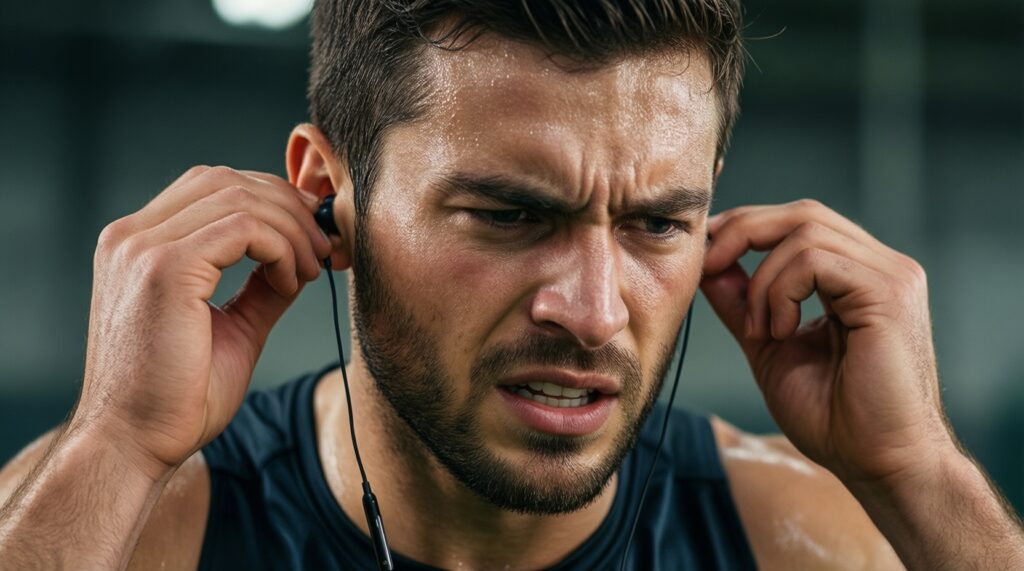
Verdict: Discomfort and poor hygiene lead to bad fit, higher volume, and worse outcomes over time.
- Buying in-ear for sports without testing tip material: some tips slip with sweat, forcing higher volume and constant readjustment.
- Using the wrong tip size: weak seal = thin sound = you turn it up; too tight = pressure and irritation.
- Assuming ANC makes roads safer: cancellation can remove cues you rely on (bikes, scooters, honks).
- Leaving transparency on in heavy wind: mic wind noise can mask both music and real-world sounds.
- Ignoring cleaning: dirty tips and nozzles reduce sound and can irritate the ear canal; clean after sweaty sessions.
- Overvaluing "more bass" for outdoor runs: bass-heavy tuning often pushes you to louder listening in traffic noise.
- Choosing open-ear without checking hotspots: pressure near the ear/temple can become painful on long runs or under helmets.
- Wearing either type too long at high volume: fatigue creeps in; take short breaks on long sessions and keep levels moderate.
Practical Buying Guide: Best Budget Choices and Trade‑Offs

Best for road-first safety: a stable open-ear sport design you can keep at moderate volume while still hearing traffic. Best for gym + bass per baht: an in-ear with strong passive isolation and comfortable tips (often the best budget value). Best for mixed commute and treadmill: in-ear with dependable transparency plus ANC you can disable outdoors.
Common Practical Concerns and Quick Answers
Is open-ear always safer than in-ear on roads?
Usually safer for awareness, but only if you keep volume reasonable and the fit is stable. If you blast open-ear loudly, you can still miss cues.
Can I run with ANC on if I use transparency mode sometimes?
Use transparency as the default for street segments and switch only in controlled areas. If mode switching is slow or unreliable, avoid ANC for road-heavy routes.
Do in-ears fall out more than open-ear during sports?
It depends on tips and ear shape. Sport in-ears with wings/hooks can be very secure; poorly fitting tips are the main cause of slipping.
What's the single biggest upgrade for sound quality on a budget?
Better fit and seal (tips for in-ear, stability for open-ear). A correct fit improves bass, clarity, and perceived loudness without extra features.
Will open-ear headphones annoy people around me?
They can leak sound, especially in quiet parks or transit. If you train near others, keep volume lower or switch to in-ear in crowded areas.
How do I decide quickly between these two types?
If your route is traffic-heavy, default to open-ear. If you mostly train indoors or want maximum bass and focus, pick in-ear and manage safety with ambient modes and volume discipline.