
To spot a real Kickstarter gadget versus vaporware, verify three things: a competent team with relevant track record, a prototype demo that proves the hardest technical claims, and credible manufacturing evidence (tooling, suppliers, test plans). Use the checks below before you treat any campaign as แก็ดเจ็ต Kickstarter น่าลงทุน or share a รีวิวแก็ดเจ็ตจาก Kickstarter.
Critical signals that separate real Kickstarter gadgets from vaporware
- Clear, verifiable prototype evidence for the campaign's hardest claim (not just renders and edits).
- Manufacturing specifics: materials, processes, suppliers, and what is already paid or reserved.
- Transparent delivery plan with realistic dependencies (certification, tooling, firmware, shipping).
- Consistent answers across comments, updates, and external interviews-no shifting specs.
- Refund and risk language is concrete (what happens if X fails), not vague "we'll try".
- Third-party traces exist: prior products, GitHub/app store history, patents, or reputable partners.
| Red flag you can observe | Verifiable proof you should demand | How to check safely (no special access) |
|---|---|---|
| Only glossy renders; no hands-on footage | Uncut video showing the gadget performing the hardest feature | Look for continuous shots, visible UI/latency, and real-world constraints (light, noise, distance) |
| "AI/secret sauce" claim without constraints | Measurable limits: range, battery life, accuracy, edge cases | Check if they publish failure modes and compare specs to known physical limits |
| Timeline promises mass production "next month" | Tooling status, DFM/DFT notes, pilot run plan | Scan updates for supplier names/types and photos of fixtures, jigs, test rigs |
| Creator avoids questions in comments | Consistent, dated answers and corrections in updates | Sort comments by newest; track whether the same question gets different answers |
| Price far below comparable products | Bill-of-materials logic and margin explanation (even high level) | Estimate component costs from mainstream marketplaces; sanity-check shipping and duties |
| Certification ignored (battery/wireless/charger) | Plan for safety + radio compliance and test lab engagement | Look for mention of standards, test labs, and region-specific adapters |
Assessing the founding team and technical competence
Quick check (2-4 steps):
- Identify the exact people building the product (names + roles), not just a brand page.
- Verify relevant build history: shipped hardware, firmware, manufacturing, or regulated devices.
- Check whether the hardest subsystem has an owner (optics, RF, batteries, motors, AI, etc.).
- Confirm the team can support Thailand logistics: warranty, parts, and communication cadence.
This assessment fits you if you can read specs, compare alternatives, and calmly challenge claims-i.e., you're applying วิธีเลือกโปรเจกต์ Kickstarter ที่เชื่อถือได้ rather than betting on hype. Avoid doing it (or avoid backing at all) when the campaign is your only option for a mission-critical use, when you cannot tolerate late delivery, or when you need local Thai after-sales support from day one.
- What "competent" looks like: named engineers, prior shipped SKUs, clear ownership of firmware/app, and detailed risk language.
- What "not worth your time" looks like: anonymous profiles, no prior builds, and repeated "we can't share details" for basic engineering questions.
Verifying prototypes: what demonstrations must prove

Quick check (2-4 steps):
- List the campaign's hardest claim (the one competitors struggle with).
- Find evidence that the hardest claim works in real conditions, not a controlled studio.
- Confirm the demo matches the product version you'll receive (rev, materials, components).
- Look for what fails-and how they handle it.
What you'll need (tools/access):
- A desktop browser for reading comment threads and update history efficiently.
- Ability to open and scrub videos frame-by-frame (any standard player is fine).
- Optional: a throwaway checklist note (phone notes) to track claim → proof → risk.
- Access to comparable products/spec sheets to benchmark plausibility.
What a prototype demo must prove (minimum):
- Continuity: uncut or clearly segmented footage where the outcome is attributable to the device, not editing.
- Limits: latency, heat, noise, battery drain, range, calibration steps-shown, not implied.
- Repeatability: more than one run, or at least one run with visible setup and reset.
- Operator independence: not "our expert operator only"; basic use should be demonstrable.
If you notice classic สัญญาณโปรเจกต์ Kickstarter หลอกลวง (e.g., "prototype" footage that never shows the device reacting to the environment), treat it as unverified until proven otherwise.
Production readiness: tooling, suppliers and timelines
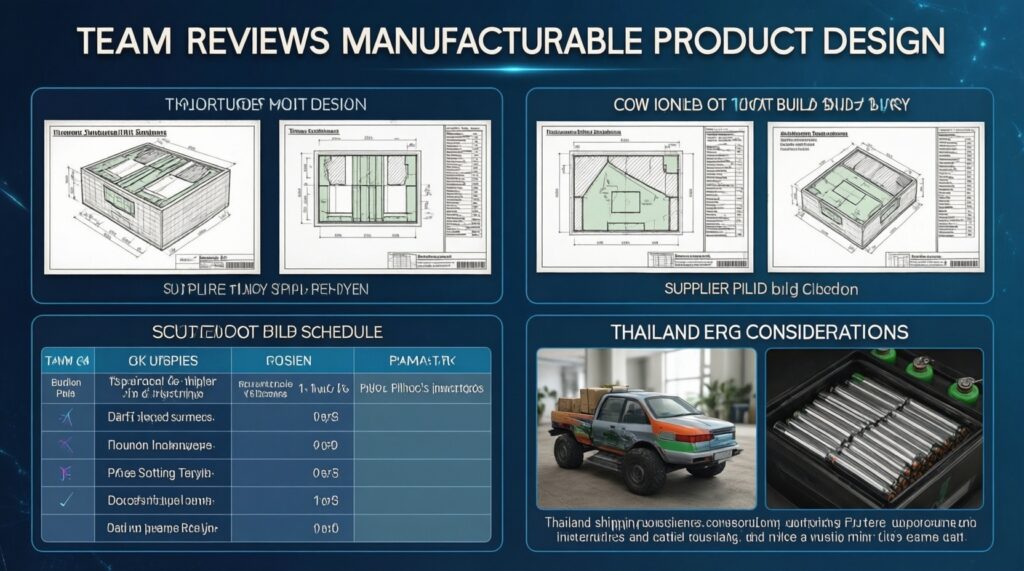
Quick check (2-4 steps):
- Confirm they have a manufacturable design (DFM), not just an engineering prototype.
- Verify a supplier strategy exists (factory type, process, assembly, testing).
- Look for a pilot build plan before mass production.
- Check shipping realism for Thailand: batteries, duties, and last-mile handling.
-
Map the product into "hard" vs "easy" parts
Write down the three hardest parts to manufacture (enclosures, optics, waterproofing, hinge tolerances, RF, battery safety). If the campaign doesn't address these explicitly, assume delays and quality risk.
- Example evidence: close-up photos of seals, hinges, internal layout, connector choices.
-
Demand proof of tooling progress (or a credible plan)
For injection-molded plastics, CNC metal, or custom gaskets, there should be mention of tool design, lead times, and iteration. "Tooling starts after funding" can be fine, but they must show DFM intent and a schedule that includes rework.
- Look for: mold-flow/DFM notes, fixture photos, early T0/T1 sample discussion (without requiring jargon).
-
Check supplier specificity without doxxing
They don't need to publish factory addresses, but they should state the manufacturing model: OEM/ODM, contract manufacturer, final assembly location, and QA method. Vague "partner factories" with no process detail is a reliability warning.
- Safe verification: consistency across updates; photos that match the described process (assembly line vs bench builds).
-
Validate the timeline by dependencies (not dates)
Break the schedule into dependencies: EVT → DVT → PVT (or similar), certification, pilot run, packaging, freight, regional fulfillment. If they promise dates but omit dependencies, treat the dates as marketing.
- Thailand-specific: battery and wireless shipments often require special handling; ask how they ship and declare goods.
-
Scrutinize quality control and test coverage
Reliable teams describe what they test (power, charging, sensors, RF, waterproofing) and how failures are handled (rework vs scrap). If QC is only "we'll test every unit," it's incomplete without method.
- Look for: test jigs, pass/fail criteria, firmware update procedure, serial-number tracking.
-
Confirm after-sales readiness for parts, firmware, and warranty
For a gadget shipped to Thailand, the practical question is not only "will it arrive," but "can it be supported." Evidence includes spare parts strategy, firmware update path, and a clear warranty process.
- If the gadget relies on an app/cloud, check whether they commit to OS update support and data handling basics.
Fast-track mode: a 4-point production reality filter
- Find one update that shows manufacturing artifacts (fixtures, test rigs, pilot parts), not just packaging mockups.
- Identify one named process owner (manufacturing/QA/firmware) and one named risk.
- Confirm there is a pilot build step before mass shipping.
- Check Thailand shipping constraints (battery/wireless) are acknowledged with a method, not a promise.
Backer data and financial transparency to interpret
Quick check (2-4 steps):
- Read the "Risks and challenges" section and compare it to what backers ask in comments.
- Check whether updates address delays with causes, corrective actions, and new milestones.
- Look for consistency: specs, pricing, and inclusions should not drift quietly.
- Validate that the creator communicates like an operator, not like an advertiser.
Checklist (use as your go/no-go gate):
- The budget logic is plausible (tooling, certification, shipping, warranty are acknowledged).
- Reward tiers are simple and not engineered to push unrealistic "early bird" urgency.
- Shipping and taxes are explained clearly for your region (Thailand) and product type (battery/wireless).
- Updates include evidence (photos, test results, factory milestones), not only reassurance.
- Negative feedback is not deleted/ignored; the creator responds with specifics.
- Stretch goals do not add major engineering complexity without extending timelines.
- Refund/cancellation language is explicit (conditions, timing, method), not "case by case".
- They can explain what happens if a key part is delayed or EOL (alternative sourcing plan).
If you're asking ซื้อแก็ดเจ็ตจาก Kickstarter ดีไหม, treat this section as the practicality test: transparent operators describe constraints and trade-offs; vaporware sellers emphasize excitement and certainty.
Regulatory, safety and intellectual property checks
Quick check (2-4 steps):
- Identify whether the product uses a lithium battery, mains charging, or wireless radios.
- Check whether they mention compliance planning (safety and radio), even at a high level.
- Search for IP risk signals: obvious clones, copied visuals, or vague "patented" claims.
- Confirm user safety considerations exist (heat, skin contact, sharp parts, water exposure).
Common mistakes that cause real-world failure (and what to look for):
- Ignoring battery safety: no mention of protection circuits, charging behavior, or thermal management.
- Overlooking radio compliance: Bluetooth/Wi‑Fi/Cellular features described with no plan for certification or regional constraints.
- Unsafe charging design: unclear charger specs, no mention of certified adapters, or risky "universal fast charge" promises.
- Waterproofing hand-waves: "waterproof" claims with no test method, gasket design, or usage limits (depth/time).
- Medical/health-adjacent overclaims: implying diagnosis or treatment without acknowledging limitations and responsibility.
- IP ambiguity: "patented" with no jurisdiction/context; or suspicious similarity to an existing brand's flagship product.
- App/cloud privacy neglect: no explanation of data handling, offline mode, or what happens if servers shut down.
- Materials not specified: skin-contact wearables without material disclosure or allergy consideration.
Identifying recurring red flags and deceptive patterns
Quick check (2-4 steps):
- List every claim that sounds "too clean" (perfect accuracy, unlimited range, no trade-offs).
- Look for proof per claim; if proof is missing, mark it as unverified.
- Track inconsistencies across the page, FAQs, and updates.
- Decide your alternative path before you pledge.
Safer alternatives when the campaign feels like vaporware:
- Wait for retail or a local distributor: best when you need a warranty path in Thailand and predictable delivery.
- Buy a proven competitor now: best when the gadget solves an immediate problem and "good enough" beats "maybe later".
- Back only after milestone evidence: best when the creator commits to updates that include pilot-build proof before late pledges close.
- Support a different type of campaign (software/printable/open designs): best when you want lower manufacturing risk and clearer delivery mechanics.
Concise practical answers for common due-diligence issues
What's the fastest way to detect a vaporware gadget?
Pick the hardest claim and demand uncut, real-world evidence for it. If the campaign can't show that single feature working under realistic conditions, treat everything else as marketing.
Is "prototype shown" enough to trust the delivery date?
No. An engineering prototype can exist months before manufacturing readiness. Trust dates only after you see tooling/pilot plans, QC/testing method, and dependency-based milestones.
How do I evaluate creator credibility without stalking them?
Check whether names, roles, and prior shipped work are easy to verify and consistent across channels. Credible teams answer technical questions precisely and correct mistakes publicly.
What comment-section behavior should worry me most?
Repeated unanswered questions about core specs, shifting explanations, or hostile deflection. Silence on shipping, refunds, or certification is also a reliable warning sign.
How can I sanity-check pricing quickly?
Compare against similar products and estimate whether the price could cover components, assembly, shipping, and warranty. If it's dramatically cheaper with no trade-off explanation, assume missing costs or missing reality.
When is backing still reasonable even if some proof is missing?
When the missing proof is about non-core "nice-to-have" features, and the core function is clearly demonstrated. Reduce risk by pledging at the lowest tier you're comfortable losing.